joinanees5@gmail.com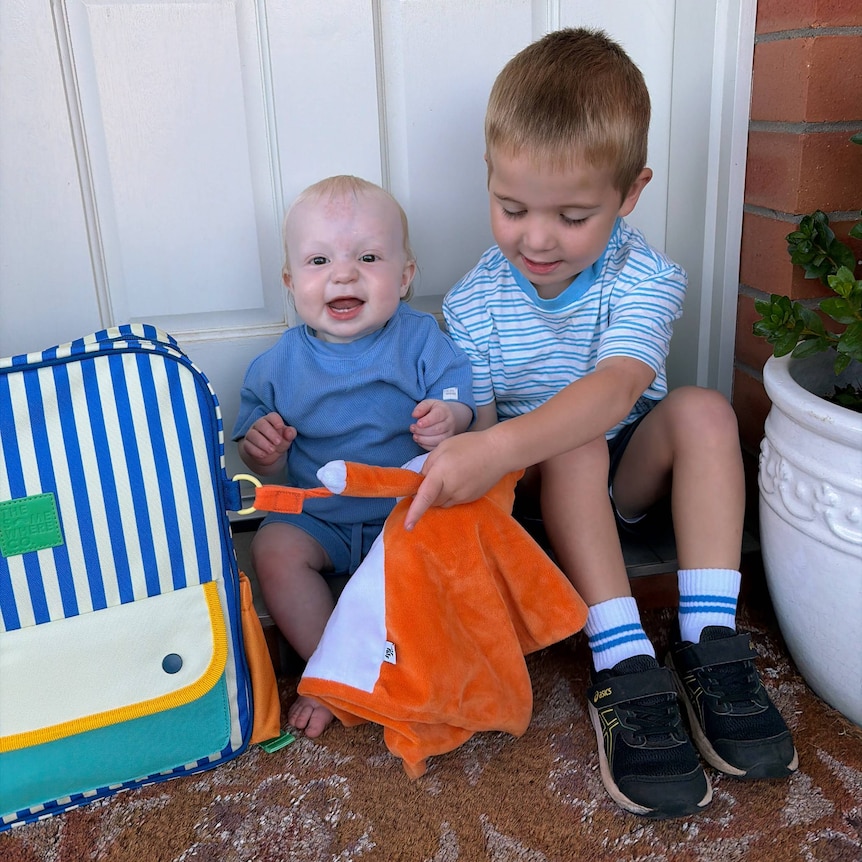
Paige Edgar never imagined the hardest part of her one-year-old son’s brain cancer diagnosis would be getting him to treatment.
Every month, her family makes a five-hour-long trip from Dubbo to Sydney so Wiley can receive specialist medical care not available locally, a journey now made even more difficult by rising fuel costs.
“We are able to give him his trial drug orally at home, but every four weeks we have to travel to Sydney to have him checked over,” Ms Edgar said.
“The petrol [price] rises and closure of the [Great Western] Highway over the mountains has completely changed our plans as to how we would travel.
“We are now looking to seek flights rather than driving [to Sydney].”
Wiley (left) has been travelling to Sydney for treatment since he was six weeks old. (Supplied: Paige Edgar)
Ms Edgar is supported by charity Country Hope, which helps families with a child diagnosed with cancer or other life-threatening illnesses.
“Country Hope is amazing, they cover the difference of what [the Isolated Patients Travel and Accommodation Assistance Scheme] covers,” she said.
Her story is not unique.
Her family is one of a growing number of regional families turning to charities for help as rising fuel prices force more people to ask for assistance to access essential medical care.
“Families are very stressed,” Country Hope regional coordinator Donna Falconer said.
Little Wings flies children from regional NSW and Queensland to metropolitan centres for treatment. (Supplied: Little Wings)
Charities stretched
Support organisations say they are being inundated with calls from families who would normally fund their own travel but are struggling to cover the cost of fuel, accommodation and time away from work.
“We’ve had some people contacting their specialists to say, ‘Do we really need to come?'” Ms Falconer said.
“We are in the position that we won’t let families do that because it is vital for these children to have those checks.”
The financial pressure is exposing broader challenges in regional health access, particularly for patients who need to travel long distances for specialist treatment.
Aeromedical charity Little Wings provides free flights for sick children and their families living in regional and remote NSW, Queensland and ACT.
Clare Pearson says Little Wings is being hit by a rise in aviation fuel costs. (Supplied: Little Wings)
Chief executive Clare Pearson said the organisation was being impacted by the 50 per cent rise in aviation fuel prices since the war in the Middle East began.
“At the end of the day, the budget for fuel is limited, and so we are seeing a dramatic cut in flights we are able to deliver on,” she said.
“We’ve cut flights by 40 per cent and we are reviewing it daily.”
“It’s [affected] about 36 families a week.”
On the ground, services like Macquarie Homestay in Dubbo are also feeling the strain, with growing waitlists for subsidised accommodation as more people seek help to access essential treatment.
Managing director Rod Crowfoot said some people had cancelled their stays due to the price of fuel.
“It was purely an affordability thing, [one person] had to come down for an appointment but decided the cost of fuel was too great so decided to cancel,” he said.
Macquarie Home Stay provides subsidised accommodation for rural patients. (ABC Western Plains: Kenji Sato)
More assistance required
Dubbo MP Dugald Saunders has called for a review of the Isolated Patients Travel and Accommodation Assistance Scheme (IPTAAS), which helps subsidise travel for rural patients in NSW.
The last review was carried out in 2022, when reimbursement rates were increased.
“At that stage there were a lot of things that were lagging behind and four years on it feels like there’s a lot more that is lagging now,” Mr Saunders said.
Mr Saunders said the scheme was no longer keeping pace with the true cost of travel and charities were being left to fill the gap for families.
Dugald Saunders says the IPTAAS scheme should be reviewed. (ABC Western Plains: Kenji Sato)
“It’s a difficult scenario, and no-one is saying that money grows on trees and it would be easy to do this.
“But people will have to opt out of receiving treatment if there is not some sort of change here.”
A spokesperson for NSW Health said in a statement that “the availability and pricing of fuel is being closely monitored by the NSW government and the Commonwealth government, who are updating the jurisdictions as the situation develops”.
They added that through the IPTAAS scheme, “financial support is available for private vehicle travel, public transport, taxis and ride-share services, flights and accommodation when overnight stays are required”.