joinanees5@gmail.com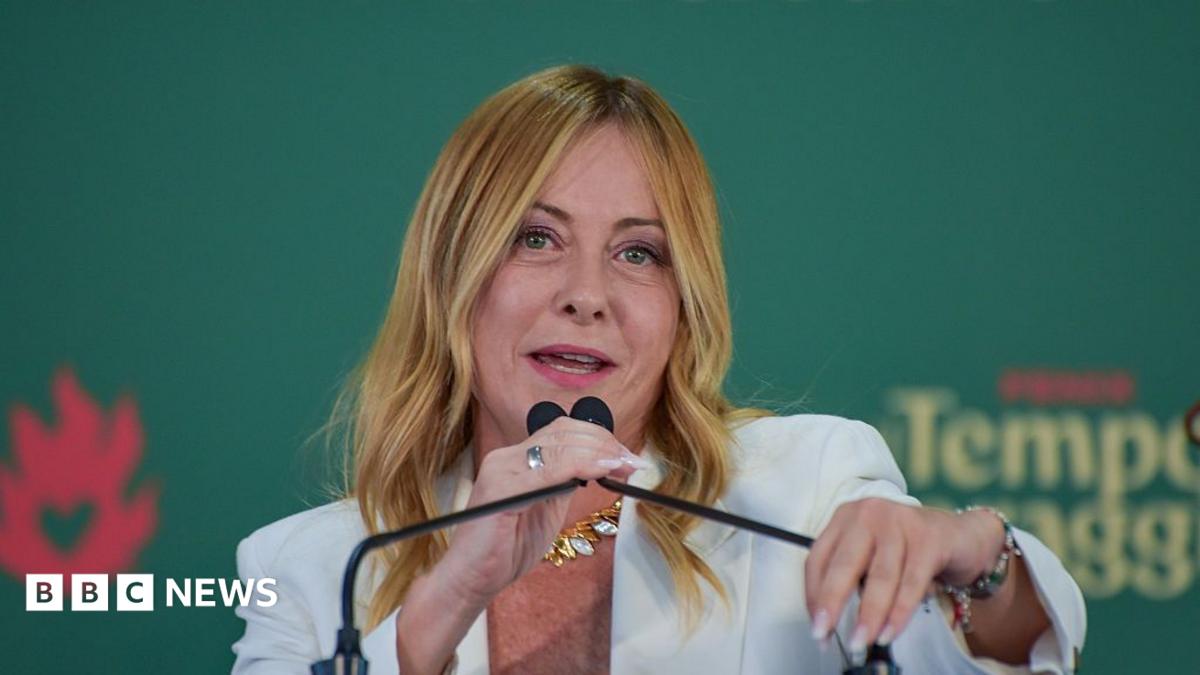
The Italian government has approved a ban on the burqa and niqab in schools, along with a limit on the share of pupils who speak little Italian in any one class.
A 30% cap will be imposed on children without Italian citizenship or poor knowledge of the Italian language in the first year of primary, middle and high school.
Prime Minister Giorgia Meloni described the measures as “common-sense tools that do not divide but really help to integrate”.
Opposition parties accuse the government of pandering to the policies of the hard-right Futuro Nazionale party, ahead of a general election next year.
Education Minister Giuseppe Valditara has said the limit is “purely linguistic” rather than one of citizenship, while he has sought to frame the ban on the niqab and burqa as a matter of gender equality.
“You must go to school with your face uncovered,” Meloni said while announcing the plans on Sunday, adding that no-one could decide that a young woman should hide herself in the name of tradition.
There were several drafts of the decree ahead of Thursday’s council of ministers meeting, however the core details were clear.
The veil ban would apply to the burqa and niqab, but not the hijab, which leaves the face visible.
The niqab is a veil for the face that leaves the area around the eyes clear. However, it may be worn with a separate eye veil. It is worn with an accompanying headscarf.
The burka is a one-piece veil that covers the face and body. Often there is a mesh screen around the eyes to see through.
Non-Italian citizens make up 11.6% of pupils in Italy’s schools, according to the research institution Fondazione ISMU.
The 30% limit on pupils who speak limited Italian will cover separate stages of education differently.
In primary schools, it would cover non-Italian citizens who have either not been born in Italy or who have not attended at least two years of nursery school.
In lower- and upper- secondary schools, it would cover pupils without Italian citizenship who have not successfully completed at least three years in the Italian school system.
Local school offices would be asked to spread pupils with little Italian language skills more evenly among nearby schools. Where that is not possible, exemptions would apply, with extra Italian teaching.
The aim was to avoid “ghetto classes”, the education minister explained.
The draft also goes further on parents, according to the Ansa news agency. Schools would have to report to social services cases in which persistent language barriers among those with parental responsibility hinder a child’s integration. Free Italian courses would be offered.
The measure is a decree law, meaning it can take effect immediately, but must be ratified by parliament within 60 days.
Italy already has guidance on Italian language at schools. A 2010 ministerial notice under then-Education Minister Mariastella Gelmini set a 30% limit “as a rule” on pupils without Italian citizenship. The new decree puts the limit into law.
The political opposition says the plan is as much about politics as schools.
Opponents accuse Meloni of pandering to Roberto Vannacci, a retired military general who leads the hard-right Futuro Nazionale party and is seen as a threat to the governing coalition’s right flank.
The leader of the centre-left Democratic Party (PD), Elly Schlein, called the plan propaganda and impossible to implement. PD deputy and chamber vice-president Anna Ascani also accused the government of propaganda at the expense of schoolchildren.
Valditara, speaking by video link from New York at a press conference rejected the charge.
“We are not chasing Vannacci; if anything, he is chasing us,” he said.
Vannacci said he agreed with the measures, but they should have come years ago.
The League’s Matteo Salvini, who launched a separate package of measures on what he called “political Islam” on Wednesday, accused Vannacci of “continually voting against the government”.
Salvini said he hoped Futuro Nazionale would back the League’s new proposals.